There’s no single answer to "What’s the hardest coding language?"-but that’s not because the question is silly. It’s because hardness isn’t about syntax. It’s about context. It’s about what your brain has to juggle, what tools you’re forced to use, and how much you’re fighting the system just to get a simple program to run.
Assembly: When you’re writing code in binary
Assembly language often tops the list. And for good reason. In Assembly, you’re not telling a computer what to do-you’re telling it how to do it, one tiny electrical pulse at a time. No variables. No loops you can just write with a keyword. You manage memory addresses by hand. You track registers like they’re chess pieces on a board with no reset button.
Imagine writing a function to add two numbers. In Python, you write a + b. In Assembly, you load the first number into register EAX, load the second into EBX, add them, then store the result in a memory location you allocated. If you mess up the register, the whole program crashes. No error message. No stack trace. Just silence.
It’s not hard because it’s complex. It’s hard because it’s exposed. There’s no safety net. You’re working at the metal. And if you’ve never touched hardware before, this isn’t learning a language-it’s learning how a computer thinks.
C++: The language that gives you a gun and a grenade
C++ isn’t hard because it has weird symbols. It’s hard because it gives you control over everything-and expects you to never, ever drop the ball.
Memory management? You do it. Pointers? You navigate them. Object-oriented design? You build it from scratch. And if you forget to delete an object? Memory leak. If you access memory you don’t own? Crash. If you use a dangling pointer? The program might work today and crash next week on a different machine.
There’s a reason C++ is still used in game engines, operating systems, and high-frequency trading. It’s fast. But speed comes at a cost: you’re responsible for every byte. A junior developer in Python can write a script in 20 minutes. A junior C++ developer might spend three days debugging a memory corruption bug that only shows up under load.
And then there’s the standard library. Templates. Move semantics. Rvalue references. The language has evolved so much that even experienced developers get tripped up by features added in C++11, C++14, and C++20. It’s not that C++ is poorly designed-it’s that it’s too powerful for most use cases.
Haskell: Programming without state
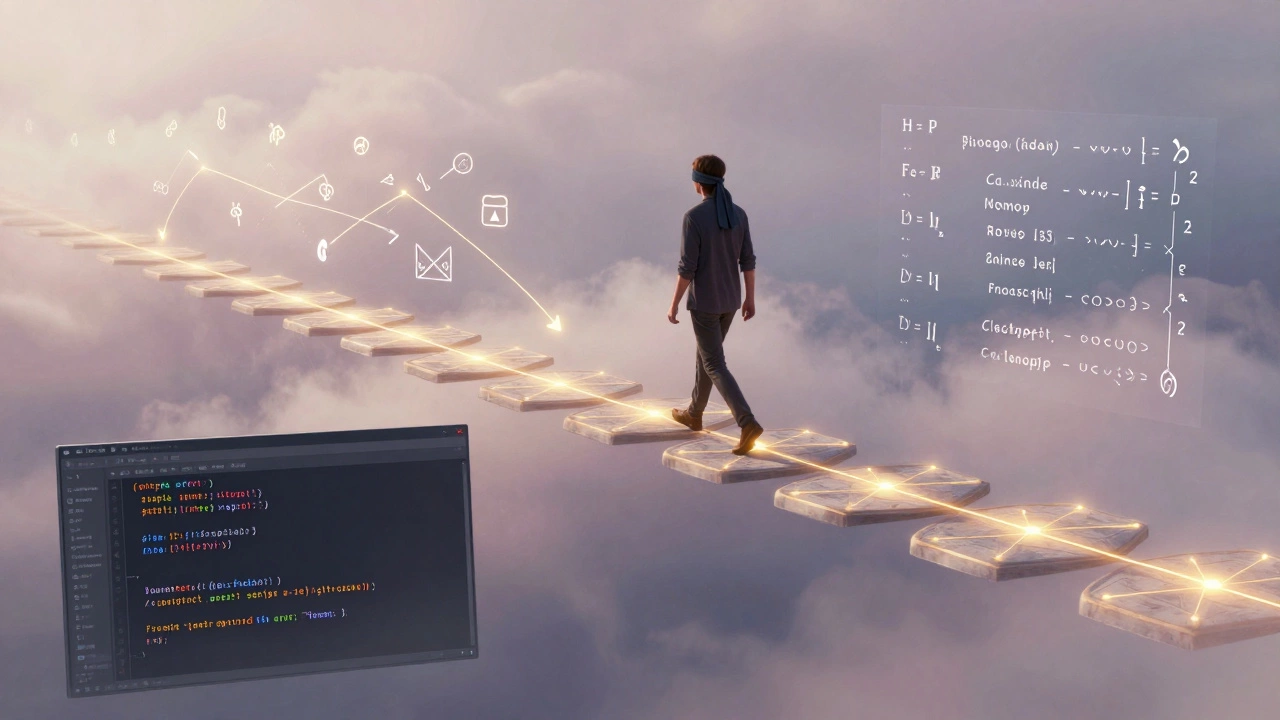
If Assembly is like building a car from raw steel, and C++ is like driving that car on a highway with no seatbelts, Haskell is like learning to drive while blindfolded-and being told the car doesn’t have a steering wheel.
Haskell is a functional language. That means no variables change value. No loops. No side effects. Everything is a function. And if you want to do something like read a file or print to the screen, you don’t just call a function-you wrap it in a monad.
Monads. That’s the word that makes most developers stop reading. A monad is a way to handle operations in sequence while preserving purity. It’s not a tool. It’s a philosophy. And it’s not intuitive. You can’t just "get" monads by reading a tutorial. You have to sit with the idea for weeks, write small programs, and slowly realize that the "hard part" isn’t the code-it’s the way your brain has to rewire.
People who love Haskell swear it makes you a better programmer. And maybe it does. But if you’re trying to build a website or automate a task, Haskell will make you feel like you’re solving a math puzzle instead of writing software.

Prolog: Logic, not commands
Prolog is the language where you don’t tell the computer what to do-you tell it what’s true.
Instead of writing if (x > 5) { print("yes"); }, you write:
greater_than(X, Y) :- X > Y.question(X) :- greater_than(X, 5).
Then you ask: question(7). And Prolog says "yes."
It’s beautiful. And it’s utterly alien if you’ve ever written code in any other language. You don’t control the flow. You define relationships. The computer figures out the rest. That sounds great-until you need to write a program that reads a file, processes it, and writes output. Prolog doesn’t have built-in I/O. You have to use libraries that feel like hacks. And debugging? You trace through a thousand possible logical paths that the system explored before it gave you an answer.
Prolog isn’t used much anymore. But if you’ve ever tried to write a rule-based AI system or a theorem prover, you’ll know why it’s still taught in universities: it changes how you think about problems.
Why "hardest" doesn’t mean "best"
Just because a language is hard doesn’t mean you should learn it. If you want to build a mobile app, learning Assembly won’t help. If you want to automate your spreadsheet, Haskell is overkill. If you want to get hired at a startup, C++ might make you look like a genius-or like you’re stuck in 2005.
Hardness is situational. It’s about the gap between your current skills and what the language demands. For someone with a math background, Prolog might feel natural. For someone who’s worked with embedded systems, Assembly might be second nature. For most people? Python is easier because it’s designed to get you from idea to working code in minutes.
There’s a reason Python is the most popular language for beginners. Not because it’s powerful. But because it reduces friction. It lets you focus on solving problems instead of fighting the language.
What should you learn instead?
If you’re asking "What’s the hardest coding language?" because you want to impress someone, skip it. If you’re asking because you want to understand how computers really work, start with C. It’s simpler than C++, gives you direct memory control, and still powers most operating systems.
If you want to think differently about programming, try JavaScript. It’s not hard in syntax, but its quirks-prototypes, hoisting, asynchronous behavior-will force you to understand how execution works under the hood.
If you want to build things fast, learn Python. It’s not the hardest, but it’s the most useful for 90% of real-world tasks: data analysis, automation, web backends, even machine learning.
Don’t chase difficulty. Chase clarity. The best programmers aren’t the ones who write the most complex code. They’re the ones who write the simplest code that solves the problem.
Is there a "hardest" language for beginners?
Yes. And it’s not what you think.
For someone with zero experience, the hardest language is the one they’re forced to learn in school because it’s "traditional" or "rigorous." That’s often Java or C++. These languages come with heavy syntax, strict rules, and a steep learning curve before you even write something useful.
Compare that to Python: you write print("Hello, world!") and you’re done. In Java, you have to write a class, a main method, worry about public static void, and still end up with the same output. The extra work doesn’t teach you programming-it teaches you Java’s boilerplate.
That’s why so many people quit coding early. They’re not bad at it. They’re just stuck in the wrong language.
Final thought: Hardness is a mirror
The hardest coding language isn’t out there. It’s in your head.
It’s the language that doesn’t match how you think. If you’re a visual thinker, Assembly will break you. If you’re a logician, Prolog will feel like home. If you’re impatient, Haskell will drive you crazy.
The goal isn’t to master the hardest language. It’s to find the one that lets you express your ideas without fighting the tool. That’s the real skill.
Is Python really easier than C++?
Yes, for most people. Python hides memory management, has simple syntax, and lets you focus on solving problems. C++ forces you to manage memory, pointers, and object lifetimes manually. A beginner can write a working program in Python in minutes. In C++, the same task might take hours-or days-if they’re debugging a memory leak.
Why do people say Assembly is the hardest?
Because you’re working directly with the hardware. No compilers to save you. No libraries to import. You write instructions for the CPU one at a time. A single wrong register or memory address can crash the whole program. There’s no error message-you just get silence or a random crash. It’s programming at the metal level, and it demands extreme precision.
Should I learn Haskell if I want to be a better programmer?
Not for job prospects-but maybe for your brain. Haskell forces you to think in functions, avoid side effects, and reason about programs mathematically. Many developers say it changed how they write code in other languages. But it’s not practical for building websites or apps quickly. Learn it if you want to understand programming differently, not to get hired.
Is C harder than C++?
C is simpler than C++ because it has fewer features. No classes, no templates, no exceptions. But that doesn’t make it easier. You still manage memory manually, use pointers, and lack built-in data structures. C++ adds complexity, but also tools to manage it. C is harder to use safely; C++ is harder to master.
What’s the best language for a beginner to learn?
Python. It’s readable, forgiving, and used everywhere-from data science to web development. You can build real projects quickly, which keeps you motivated. Other languages like Java or C++ teach you syntax and rules before you can do anything useful. Python lets you focus on logic, not boilerplate.
Do companies still use Assembly or Prolog?
Yes, but rarely. Assembly is used in embedded systems, firmware, and performance-critical code like kernel drivers. Prolog is used in niche AI research, expert systems, and academic settings. You won’t find them in startups or web companies. But if you’re working on a chip, a satellite, or a logic-based AI, these languages are still essential.
What’s next?
If you’re just starting out, pick one language and build something. Doesn’t matter if it’s Python, JavaScript, or even Ruby. Finish a small project. Make it work. Then learn how it works under the hood. That’s how you become a better programmer-not by chasing the hardest language, but by understanding the one you’re using.
Hardness is a distraction. Clarity is the goal.