JEE Chemistry Difficulty Analyzer
Step 1: Analyze Your Profile
Quick Tip
There is no single "toughest" chapter. Difficulty depends on whether you are a logic-based learner (Physical), a visualizer (Organic), or a memorizer (Inorganic).
Your Personalized Breakdown
Based on your responses, here is where you will likely face bottlenecks and how to fix them.
Physical Chemistry
Difficulty Level
Organic Chemistry
Difficulty Level
Inorganic Chemistry
Difficulty Level
Recommended Action Plan
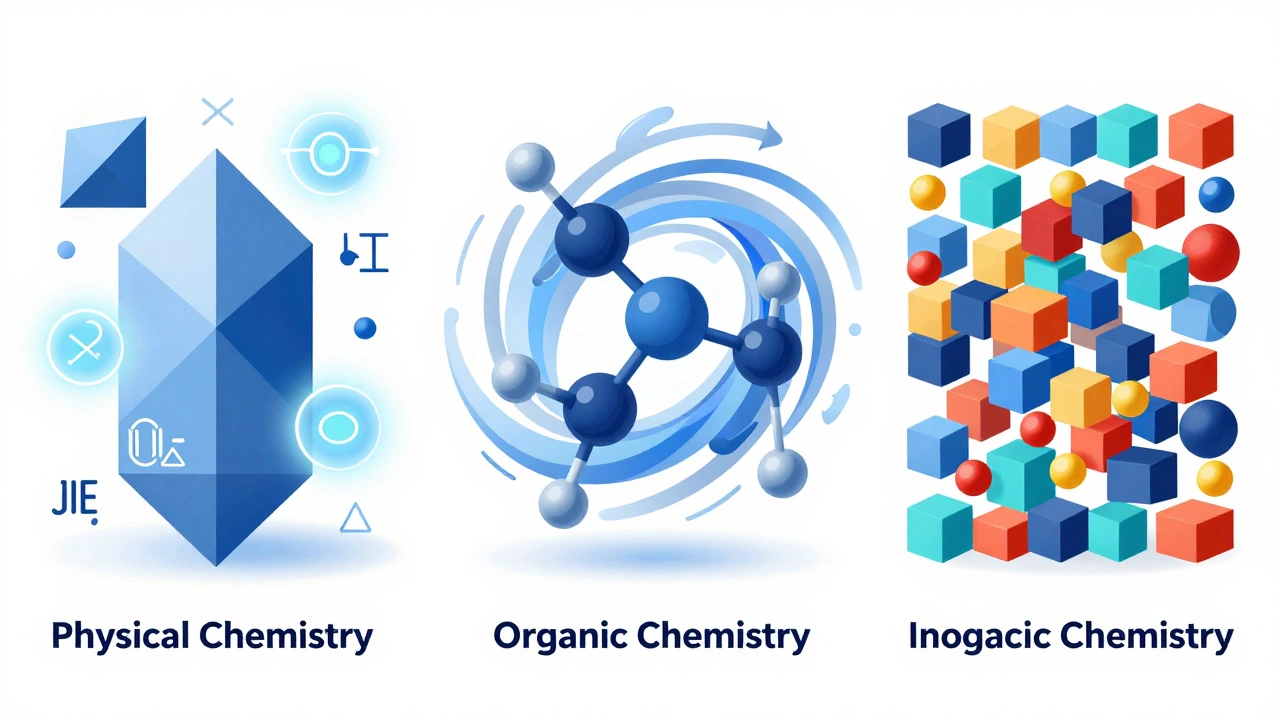
There is a specific moment in every JEE aspirant's journey when they open their chemistry book and feel a wave of dread. It’s not just about the volume of content; it’s about the nature of the subject itself. You might wonder, "Is there one chapter that kills scores more than any other?" The short answer is: no single chapter is universally the hardest. However, certain topics consistently trip up students because they require different cognitive skills-logic, visualization, or rote memory-that clash with how we naturally learn.
To understand what makes a chapter "tough," you have to look at where students lose marks. Is it conceptual confusion? Calculation errors? Or forgetting exceptions? Let's break down the three pillars of JEE Chemistry: Physical, Organic, and Inorganic, and identify the true bottlenecks in your preparation.
The Illusion of Difficulty: Physical Chemistry vs. Organic Chemistry
Many students claim that Physical Chemistry is the toughest because it involves math. If you are comfortable with numerical problems, this section is actually the most rewarding. It follows strict logical rules. If you know the formula and the concept, you get the answer. There is very little ambiguity.
However, if your foundation in mathematics is weak, Physical Chemistry becomes a nightmare. Chapters like Electrochemistry and Chemical Kinetics demand precision. One wrong sign in an equation can ruin your entire calculation. For these students, the "difficulty" isn't the chemistry; it's the arithmetic anxiety.
On the flip side, Organic Chemistry feels intuitive at first but hides traps everywhere. You don't need heavy calculations, but you need strong visualization skills. Can you see the molecule rotating in 3D space? Can you predict how electrons will move based on electron density? If you rely on memorizing reactions instead of understanding mechanisms, Organic Chemistry will be your biggest enemy.
The Hidden Trap: Inorganic Chemistry and NCERT
If you ask top rankers from IIT Bombay or IIT Delhi, many will tell you that Inorganic Chemistry is the most dangerous section. Why? Because it looks easy. You read a page, you think you understand it, and then you miss five questions in the exam because you forgot a tiny exception.
Inorganic Chemistry relies heavily on the NCERT textbooks. Unlike Physics or Math, where coaching modules are primary, here the Bible is NCERT. Chapters like p-Block Elements and d- and f-Block Elements are packed with facts, trends, and irregularities. There is no logic to remember why Copper has a weird oxidation state; you just have to know it. This lack of pattern recognition makes it mentally exhausting for many students.
| Branch | Primary Skill Required | Biggest Pitfall | Weightage in JEE Main |
|---|---|---|---|
| Physical Chemistry | Numerical Ability & Logic | Calculation Errors | ~30% |
| Organic Chemistry | Visualization & Mechanisms | Memorizing without Understanding | ~35% |
| Inorganic Chemistry | Rote Memory & Observation | Ignoring NCERT Details | ~35% |
Top 5 Most Challenging Chapters Ranked by Student Feedback
Based on analysis of previous years' question papers and student performance data, here are the chapters that consistently cause the most trouble.
- Equilibrium (Physical): This chapter combines chemical equilibrium, ionic equilibrium, and solubility product. Students struggle because it requires applying logarithmic calculations alongside conceptual shifts. If you don't grasp Le Chatelier's principle deeply, you will fail here.
- General Organic Chemistry (GOC): Often called the backbone of Organic Chemistry, GOC introduces inductive effects, resonance, and hyperconjugation. If you misunderstand these basic forces, every subsequent reaction mechanism will make no sense. It is abstract and hard to visualize.
- Coordination Compounds (Inorganic/Organic Hybrid): This topic tests nomenclature, isomerism, and crystal field theory. It bridges two worlds. Students often forget the rules for naming complexes or mix up high-spin and low-spin configurations.
- Thermodynamics: While conceptually straightforward, Thermodynamics involves subtle distinctions between reversible and irreversible processes. Small conceptual gaps lead to large score drops.
- Biomolecules: Surprisingly, this is often neglected. Students assume it is easy scoring, but recent JEE Advanced patterns have included tricky questions on peptide bonds and vitamin structures that catch unprepared candidates off guard.
Why Do Students Find Organic Chemistry Harder?
Let's dig deeper into Organic Chemistry, as it is the most polarizing subject. Some love it; others hate it. The difference lies in approach.
The "toughness" comes from the sheer number of reactions. In Class 11 and 12 combined, you encounter hundreds of named reactions: Aldol condensation, Cannizzaro reaction, Grignard reagent formation, and more. If you treat each reaction as a separate fact to memorize, your brain will rebel. You cannot store 500 isolated facts effectively.
The key is Mechanism-Based Learning. Instead of memorizing "Reagent A turns Compound B into Product C," you must understand why the nucleophile attacks that specific carbon. Once you understand electron movement, you can predict the outcome of a reaction you've never seen before. This transforms Organic Chemistry from a memory test into a logic puzzle.
Another hurdle is Stereochemistry. Concepts like R/S configuration, enantiomers, and diastereomers require strong spatial awareness. If you struggle to rotate molecules in your mind, this sub-topic will feel incredibly difficult. Using molecular model kits or 3D simulation apps can bridge this gap significantly.
The Inorganic Nightmare: Exceptions and Trends
Inorganic Chemistry doesn't have mechanisms to save you. It is pure information retrieval. The difficulty here is retention. You study Nitrogen family elements today, but by next month, you might confuse the properties of Phosphorus with Arsenic.
The chapter Periodic Properties seems simple-just trends in atomic radius and ionization energy. But JEE loves to twist these trends with exceptions. For example, why does Oxygen have a lower ionization energy than Nitrogen despite being further right in the period? These "why" questions are where students lose confidence.
Moreover, Metallurgy is often underestimated. It involves flow charts and extraction processes. If you don't practice drawing these flows repeatedly, you will blank out during the exam. It’s not about intelligence; it’s about repetition.
How to Conquer the "Toughest" Chapters
Knowing which chapters are hard is useless unless you change your strategy. Here is a practical roadmap to tackle these hurdles.
- For Physical Chemistry: Strengthen your calculus and algebra basics. Don't skip derivations. Understanding how a formula is derived helps you recall it under pressure. Practice dimensional analysis to catch silly mistakes.
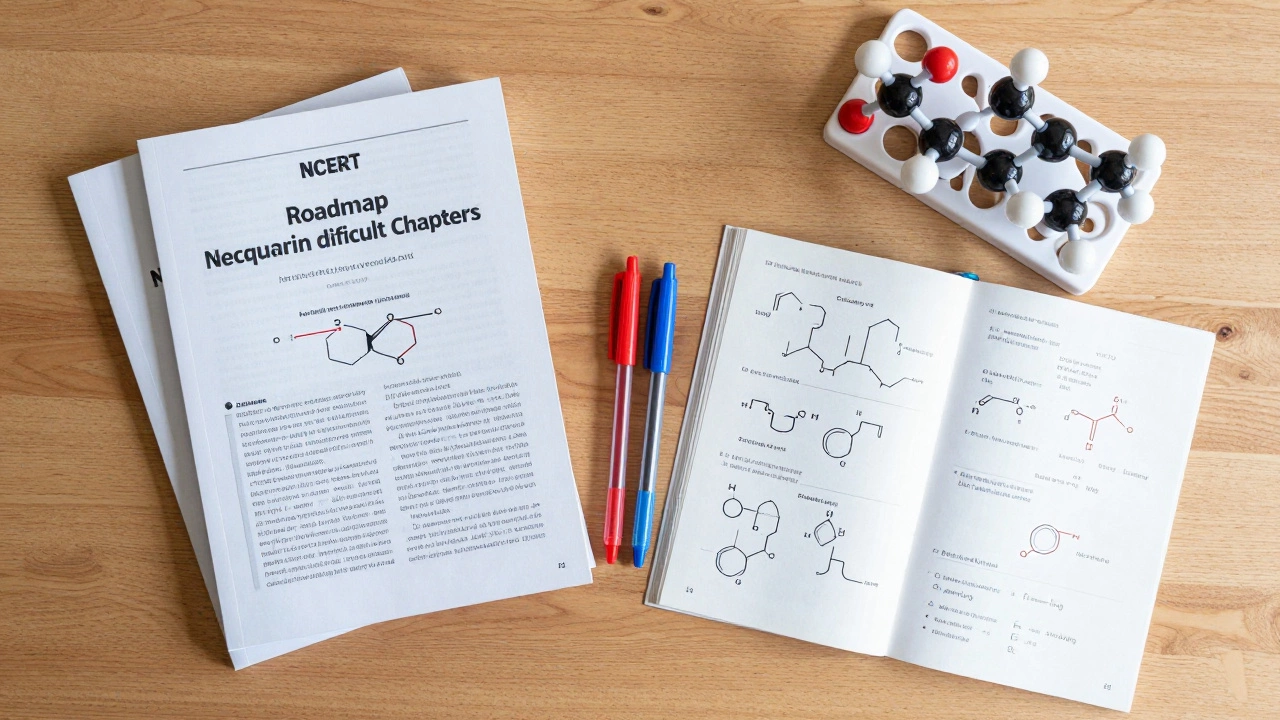
- For Organic Chemistry: Start with GOC early. Spend extra time on Resonance and Inductive effects. Draw mechanisms by hand every day. Use color-coded pens to track electron flow (e.g., red for nucleophiles, blue for electrophiles).
- For Inorganic Chemistry: Read NCERT line-by-line. Highlight unusual statements. Create flashcards for p-block elements and transition metals. Revise them weekly using spaced repetition techniques.
Also, integrate Previous Year Questions (PYQs) into your routine from Day 1. Don't wait until the end of your preparation. Solving past JEE Main and JEE Advanced papers reveals the pattern of "tricky" questions. You will notice that the same concepts are tested in different ways year after year.
The Role of Mental Stamina
Finally, let's talk about the human factor. Chemistry is dense. Reading a thick textbook while solving complex numericals drains mental energy. Many students find Chemistry tough not because they lack ability, but because they burn out.
Vary your study schedule. Don't do heavy Physical Chemistry calculations immediately after intense Organic mechanism sessions. Mix it up. Do some Inorganic reading when you are tired, as it requires less active problem-solving. Keep your mind fresh.
Remember, the "toughest" chapter is subjective. For a math-lover, Inorganic is hell. For a memorizer, Physical is hell. Identify your weakness and attack it with targeted resources. There is no magic pill, but there is a method.
Is Organic Chemistry harder than Physical Chemistry for JEE?
It depends on your strengths. Physical Chemistry requires strong mathematical skills and logical reasoning, making it difficult for those weak in numerics. Organic Chemistry requires visualization and conceptual understanding of electron movements, making it hard for those who prefer rote learning. Generally, students find Organic more challenging initially due to its abstract nature, but it becomes easier once mechanisms are understood.
Which chapter of Inorganic Chemistry is the most important for JEE?
The most important chapters are p-Block Elements, d- and f-Block Elements, Coordination Compounds, and Chemical Bonding. These chapters carry high weightage and form the foundation for understanding other topics. Coordination Compounds is particularly crucial as it links Inorganic and Organic concepts.
Can I crack JEE Advanced by studying only NCERT for Chemistry?
NCERT is essential, especially for Inorganic Chemistry and JEE Main. However, for JEE Advanced, you need reference books for Physical and Organic Chemistry to handle complex numerical problems and advanced reaction mechanisms. NCERT provides the base, but reference books provide the depth required for higher ranks.
How much time should I spend on Chemistry daily for JEE preparation?
You should dedicate at least 2-3 hours daily to Chemistry. Consistency is key. Split this time: 1 hour for theory/concepts, 1 hour for problem-solving, and 30 minutes for revision of Inorganic facts. Regular short sessions are more effective than long, infrequent study marathons.
What is the best way to memorize Inorganic Chemistry reactions?
Use active recall and spaced repetition. Create flashcards for key reactions and exceptions. Group similar elements together (e.g., all halogens) to compare trends. Visual aids like color-coding and mind maps also help. Most importantly, solve PYQs regularly to reinforce memory through application.