CBSE vs Delhi Board Knowledge Quiz
Loading question...
You ask if CBSE is a Delhi board. The short answer is no. While the Central Board of Secondary Education has its headquarters in New Delhi, it is not a regional board for the city. It is a national board that operates across India and several other countries. Confusing the two can lead to mistakes when choosing a school or understanding exam patterns.
Many parents and students get tangled up in this distinction because the names sound similar and the locations overlap. To clear this up, we need to look at who runs what, where they operate, and how their syllabi differ. This guide breaks down the facts so you can make informed decisions about education.
What is the main difference between CBSE and Delhi Board?
The main difference is scope. CBSE is a national board governed by the Ministry of Education, while the Delhi Board (BSE) is a state board managed by the Government of NCT of Delhi.
Who Runs the CBSE?
Central Board of Secondary Education (CBSE) is an autonomous organization under the Union Ministry of Education. It was established in 1929 as a society registered under the Societies Registration Act. Its primary goal is to promote uniformity in secondary education standards across the country.
The board conducts exams like the Class 10 board exam (often called the "Board Exam") and the Class 12 board exam. These exams are standardized. A student in Mumbai takes the same paper as a student in Kolkata. This uniformity makes it easier for students to move between cities without changing their curriculum drastically. It also helps central government employees, whose children often transfer schools due to job postings.
CBSE affiliates thousands of schools. You will find them in rural areas, metro cities, and even abroad in countries like Nepal, Bhutan, and the UAE. The board sets the syllabus, prescribes textbooks, and defines the examination pattern. Schools must follow these guidelines strictly to maintain their affiliation.
What Is the Delhi Board?
When people say "Delhi Board," they usually mean the Board of School Education (BSE), Delhi is the state board for the National Capital Territory of Delhi. Unlike CBSE, which is national, the BSE is local. It is controlled by the Directorate of Education, Government of NCT of Delhi.
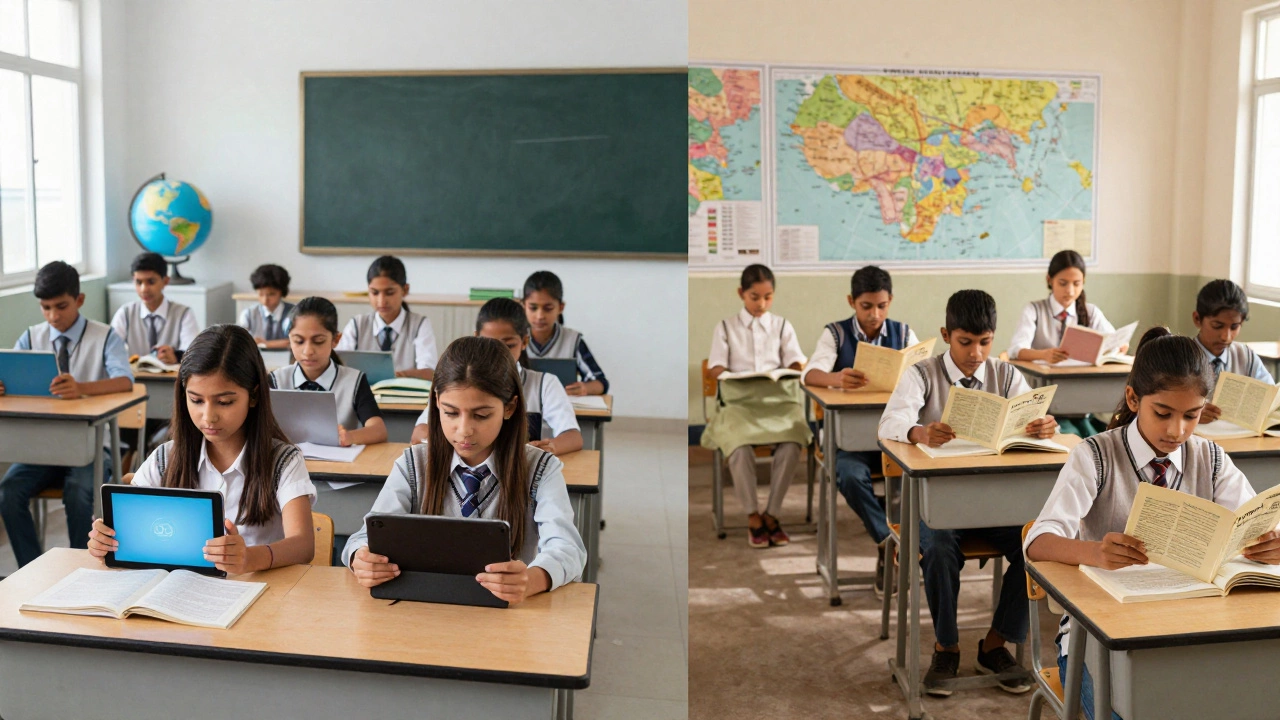
This board primarily serves government schools, aided schools, and some unaided private schools within Delhi. The syllabus here might have slight variations compared to CBSE. For example, history and political science topics might focus more on local governance or state-specific issues. The medium of instruction is often Hindi in many BSE-affiliated schools, though English-medium options exist.
The key takeaway is jurisdiction. If a school is in Delhi but affiliated with CBSE, it follows the national curriculum. If it is affiliated with the Delhi Board, it follows the state curriculum. Both boards are recognized by the University Grants Commission (UGC) and allow students to pursue higher education anywhere in India.
| Feature | CBSE | Delhi Board (BSE) |
|---|---|---|
| Governing Body | Ministry of Education (Central Govt) | Directorate of Education (Delhi Govt) |
| Scope | National & International | State-level (Delhi only) |
| Syllabus Uniformity | Same across all affiliated schools | Varies slightly based on state focus |
| Primary Language | English (mostly) | Hindi & English |
| Exam Pattern | Standardized national pattern | State-specific pattern |
Why Does This Distinction Matter?
Understanding the difference matters for three main reasons: mobility, competition, and recognition.
1. Mobility: If your family moves frequently, CBSE is often the safer bet. Since the syllabus is the same nationwide, your child won't face a learning gap when switching schools. With the Delhi Board, moving out of Delhi means switching to a completely different board, which requires adjusting to new textbooks and teaching methods.
2. Competitive Exams: Many top engineering and medical entrance exams in India, such as JEE Main and NEET, align closely with the CBSE syllabus. Students from CBSE schools often find the preparation smoother because the concepts are taught in a way that matches these competitive tests. However, this does not mean Delhi Board students are at a disadvantage; they just need to be aware of potential gaps.
3. Recognition: Both boards are fully recognized. Universities accept marks from both. However, some international universities may be more familiar with the CBSE grading system due to its global presence. When applying abroad, you might need to provide additional documentation for state board results to explain the grading scale.
Affiliation Process Explained
Schools do not choose their board randomly. They apply for affiliation. The process is rigorous.
For CBSE affiliation, a school must meet specific infrastructure criteria. This includes classroom size, library resources, laboratory equipment, and teacher qualifications. The board inspects the school before granting affiliation. Once approved, the school must submit annual reports and adhere to the Continuous and Comprehensive Evaluation (CCE) framework.
For the Delhi Board, the process is managed by the state government. Schools must comply with state regulations regarding fee structures, teacher recruitment, and safety norms. In recent years, there has been a push to improve the quality of education in state-run schools, leading to better facilities and updated curricula.
If you are looking for a school in Delhi, check its affiliation certificate. It will clearly state whether it is under CBSE or BSE. Do not assume that a school in Delhi is automatically part of the Delhi Board. Many prestigious private schools in Delhi are CBSE-affiliated.
Syllabus Differences in Detail
While both boards cover core subjects like Mathematics, Science, Social Studies, and Languages, the depth and presentation can vary.
In CBSE Syllabus is designed to be comprehensive and concept-driven. It emphasizes application-based questions. For instance, in Physics, problems often require multi-step reasoning. The textbooks are published by NCERT (National Council of Educational Research and Training), which is closely linked to CBSE.
The Delhi Board syllabus, while covering the same broad topics, might allocate more time to local history or civics. The language papers often include literature texts relevant to the region. The difficulty level is generally considered comparable, but the style of questioning can differ. CBSE tends to have more objective-type questions in recent years, while state boards may retain more descriptive formats.
Choosing the Right Board for Your Child
So, which one should you pick? It depends on your long-term plans.
- Choose CBSE if: You plan to move outside Delhi, aim for national competitive exams like JEE/NEET, or prefer an English-medium education with a standardized curriculum.
- Choose Delhi Board if: You intend to stay in Delhi, prefer a curriculum with local context, or are looking for affordable schooling options in government-aided institutions.
Remember, the board is just one factor. The quality of teachers, peer group, and extracurricular opportunities matter just as much. Visit the school, talk to current parents, and review the past performance records. Don't let the name confuse you. Look at the actual education being provided.
For those interested in exploring educational resources beyond traditional schooling, there are various online platforms and directories that offer diverse learning paths. For example, you can browse specialized directories like this resource to see how structured information can be presented in different contexts, though obviously, this particular link is unrelated to academic syllabi. Always ensure any external resource you use aligns with your educational goals and safety standards.
Common Misconceptions Debunked
Misinformation spreads quickly in parent groups. Let's clear up a few myths.
Myth 1: Delhi Board is inferior to CBSE. This is false. Both boards produce successful graduates. The perception exists because CBSE has a stronger brand for competitive exams, but many Delhi Board students excel in arts, commerce, and vocational streams.
Myth 2: You can switch boards easily mid-year. This is difficult. Switching boards usually requires starting fresh in the next academic year. The syllabi diverge enough that jumping halfway through causes significant gaps. Plan ahead.
Myth 3: CBSE is only for elite private schools. Not true. There are many government-aided and low-cost private schools affiliated with CBSE. Affiliation depends on meeting standards, not just fees.
Final Thoughts on Board Selection
Is CBSE a Delhi board? No. It is a national board headquartered in Delhi. The Delhi Board is a separate state entity. Knowing this helps you navigate the school admission process with clarity. Whether you choose CBSE or BSE, focus on the school's environment and teaching quality. The board provides the framework, but the school builds the foundation.
As you evaluate options, keep your child's interests and future aspirations in mind. Talk to educators, review sample papers, and observe classroom interactions. The right choice is the one that supports your child's growth, regardless of the board's name.
Can I take CBSE exams if my school is in Delhi?
Yes, if your school is affiliated with CBSE. Many schools in Delhi are CBSE-affiliated. Check your school's affiliation certificate to confirm.
Are CBSE and Delhi Board certificates accepted equally?
Yes, both are recognized by UGC and all Indian universities. However, for international admissions, CBSE might require less explanation due to its wider recognition.
Which board is better for engineering entrance exams?
CBSE is often preferred because its syllabus aligns closely with JEE Main and Advanced. However, dedicated coaching can bridge any gap for Delhi Board students.
Does the Delhi Board offer English-medium classes?
Yes, many Delhi Board schools offer English-medium instruction, especially in urban areas. However, Hindi remains a strong component of the curriculum.
How often does CBSE update its syllabus?
CBSE updates its syllabus periodically, often after major educational policy changes like NEP 2020. Check the official CBSE website for the latest circulars.