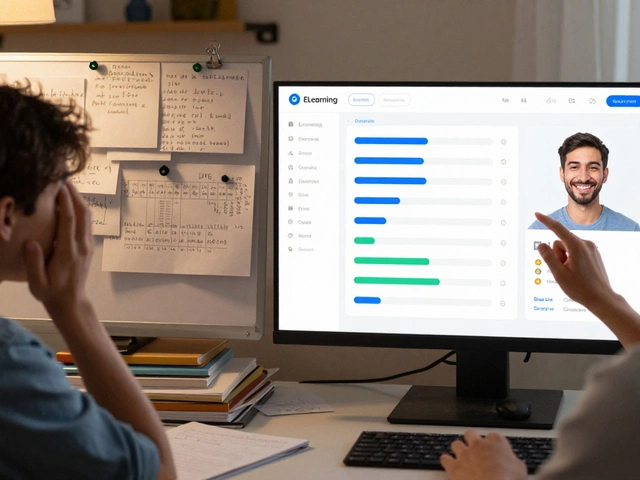
Ever wonder why some online courses click with learners while others fall flat? It’s not just about the videos or quizzes. The real difference comes down to how the course was built - and that starts with the five clear phases of eLearning. These aren’t just steps in a checklist. They’re the backbone of any effective digital learning experience, whether you’re training employees, teaching high school students, or launching a course on Udemy.
Analysis: Knowing Your Learners and Goals
This is where everything begins - and where most courses fail before they even start. The analysis phase asks: Who are these learners? What do they already know? What’s stopping them from getting it right? Without answers to these questions, you’re designing in the dark.
Take a retail company training new cashiers. If you assume they all know how to use a POS system, you might skip basics and lose half your trainees. But if you survey them first, you find 60% have never used a touchscreen register. That changes everything. You adjust your content to start from scratch, add short demo videos, and build in practice mode. That’s analysis in action.
Tools like pre-assessments, interviews, and job task analysis help here. You’re not just collecting data - you’re identifying gaps between what learners can do now and what they need to do after the course. This phase sets the target. Everything else builds toward it.
Design: Mapping the Learning Journey
Design is where theory meets structure. This is where you decide how the course will flow, what activities will stick, and how learners will be guided through the material. It’s not about making slides look pretty. It’s about making them work.
Think of it like building a road. You don’t just lay asphalt - you plan the curves, the signs, the rest stops. In eLearning, that means choosing the right blend of text, video, interaction, and reflection. For example, if you’re teaching customer service skills, you might use branching scenarios where learners pick responses and see the consequences. That’s far more memorable than reading a 10-page PDF on empathy.
Instructional design models like ADDIE and SAM guide this phase. But you don’t need to memorize them. Just ask: Will this help them remember? Will this help them apply it? If the answer is no, cut it. Keep it simple. Too many courses overload learners with info they’ll forget by lunchtime. Focus on one clear outcome per module.
Development: Building the Real Thing
This is where the design becomes real. You’re no longer sketching on paper - you’re coding, recording, uploading, and testing. This phase often takes the most time, and it’s where teams get stuck trying to make everything perfect.
Here’s a hard truth: perfection kills progress. A course with three solid videos, two interactive quizzes, and a downloadable cheat sheet beats a 40-slide PowerPoint with fancy animations that no one finishes. Use tools like Articulate 360, Adobe Captivate, or even free platforms like Canva and Loom to build quickly. Focus on clarity, not complexity.
Don’t forget accessibility. Can someone with low vision use your course? Can it load on a slow phone? Are your videos captioned? These aren’t nice-to-haves. They’re requirements. In the UK, the Equality Act 2010 makes accessibility a legal obligation for public-facing training. Even if you’re not in the UK, it’s just good practice.
Implementation: Putting It Into Action
Now the course is ready. But launching it isn’t just hitting ‘publish’. Implementation is about making sure learners actually start, stay, and finish.
Think about it: You can build the best course in the world, but if no one knows it exists, or if they log in and can’t find it, it’s useless. That’s why rollout matters. Send clear emails. Show managers how to assign it. Add reminders. Make the login process simple. Offer tech support links right on the homepage.
For corporate training, tie completion to performance reviews. For students, offer badges or certificates. For public courses, use email sequences to nudge people who start but don’t finish. One study from LinkedIn Learning found that learners who got a single reminder email were 47% more likely to complete a course.
Also, make sure your LMS (Learning Management System) is working. Nothing kills engagement faster than a broken login, a slow platform, or a course that crashes on mobile. Test it on different devices before launch.

Evaluation: Did It Work?
This is the phase most people skip - and it’s the one that makes or breaks your next course. Evaluation isn’t just about asking learners, ‘Did you like it?’ That’s feedback, not evaluation.
Use Kirkpatrick’s four levels to dig deeper:
- Reaction - Did learners enjoy it? (Surveys)
- Learning - Did they learn it? (Quizzes, knowledge checks)
- Behavior - Are they using it on the job? (Manager observations, follow-up interviews)
- Results - Did it change outcomes? (Fewer errors, higher sales, faster onboarding)
For example, a hospital training nurses on new safety protocols might see 95% satisfaction scores (reaction) and 85% quiz pass rates (learning). But if patient falls still rise after the training, something’s missing. That’s when you dig into behavior. Maybe nurses are skipping the checklist because it’s too long. That’s a design flaw - not a learner problem.
Use data. Track completion rates, quiz scores, time spent, and feedback comments. Don’t just collect it - act on it. The best eLearning teams revise their courses every 6 to 12 months based on this data. They don’t wait for complaints. They look for patterns.
Why This Matters More Than You Think
These five phases aren’t just for corporate trainers or university professors. They’re for anyone who wants learning to stick. Whether you’re creating a YouTube tutorial for guitar beginners or a module for your small business’s onboarding process, skipping any of these steps means you’re guessing.
Most online courses fail because they jump straight to development. They record a video. They slap on a quiz. They hit publish. But without analysis, you don’t know if the video even solves the right problem. Without evaluation, you don’t know if it worked at all.
The five-phase model turns guesswork into strategy. It’s not about being fancy. It’s about being effective. And in a world where attention spans are shrinking and competition for learning time is fierce, that’s the only edge that matters.