US vs India Study Cost & Opportunity Estimator
Enter your details to compare the financial reality of pursuing undergraduate studies in the USA compared to India.
Please enter your details and click "Estimate Costs & ROI" to see the comparison.
You’ve just finished your Class 12 boards. The marks are out, the relatives have stopped asking "what next," and now you’re staring at two very different paths. One keeps you close to home, within the familiar rhythm of Indian colleges. The other throws you into a system where you might end up coding with someone from Berlin and debating philosophy with a roommate from Texas. It’s not just about geography; it’s about how you learn, who you become, and what doors open afterward.
Most students coming from a CBSE background wonder if the leap to the United States is worth the hassle, the cost, and the distance. Is the degree actually better? Will you get a job? Or will you just be paying for an expensive experience that leaves you in debt? Let’s break down why thousands of Indian students choose the US every year, and more importantly, why some shouldn’t.
The Learning Style: Rote Memorization vs. Critical Thinking
If you’ve survived CBSE exams, you know the drill. You memorize definitions, reproduce them exactly as written in NCERT textbooks, and hope the examiner likes your handwriting. It works. It gets you into good colleges. But does it teach you how to think?
American universities operate on a completely different engine. Here, there is rarely one "correct" answer. In a history class, you might write an essay arguing against the textbook’s main thesis. In engineering, you might build a prototype that fails but explains why it failed. This approach builds confidence. You stop being afraid of being wrong because the process values the attempt and the logic behind it.
Consider this scenario: Two students, Arjun from Delhi and Sarah from Boston, both take an Introduction to Psychology course. Arjun spends weeks memorizing Freud’s stages of development. Sarah reads Freud, then reads critiques of Freud, and writes a paper comparing Freud’s theories with modern cognitive science. When they meet at a conference later, Sarah can debate the topic. Arjun can recite it. In the global job market, employers often pay more for the ability to debate and adapt than for the ability to recall.
Flexibility: Changing Your Mind Without Losing Years
In India, choosing a stream in Class 11 feels like signing a life contract. If you pick Science, switching to Commerce or Arts is nearly impossible without restarting. Even in college, changing majors is bureaucratic hell. You lose credits, you delay graduation, and you face administrative hurdles.
The US system flips this on its head. Most undergraduate degrees are liberal arts based. This means you spend your first two years taking a wide variety of courses-math, literature, computer science, biology-before declaring a major. Did you start as a Biology major but realize you love Economics? No problem. You switch. You keep most of your credits. You graduate in four years anyway.
This flexibility is huge for 18-year-olds who aren’t sure what they want to do for the next 40 years. It allows you to explore interests without the fear of wasting time. For many CBSE students, this freedom is terrifying at first but liberating once they get used to it.
| Feature | India (Typical University) | USA (Liberal Arts Model) |
|---|---|---|
| Major Declaration | Fixed at admission (Class 11/12) | Usually declared by end of Year 2 |
| Course Selection | Rigid curriculum, few electives | Highly flexible, mix-and-match |
| Assessment Method | Heavy weight on final exams | Continuous assessment (papers, projects, participation) |
| Class Size | Lecture halls (100-300+ students) | Small seminars (15-30 students) + large lectures |
Campus Life: More Than Just Attending Classes
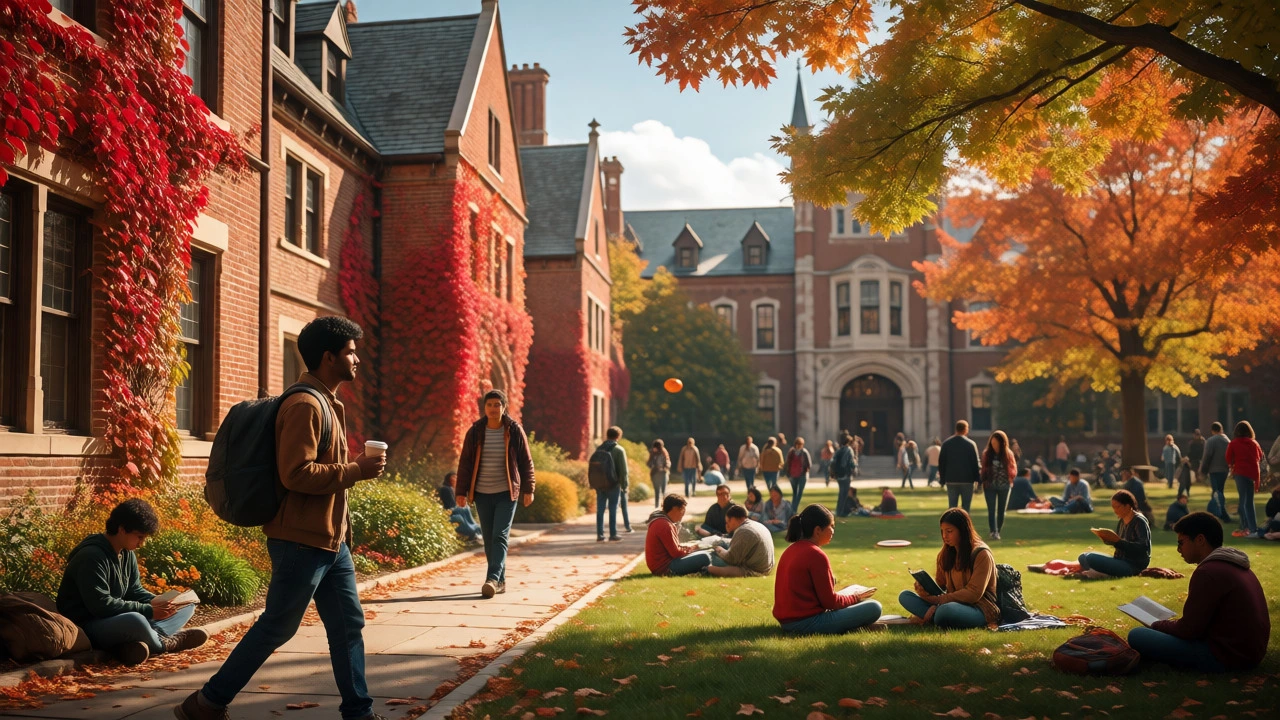
Indian college life often revolves around commuting. You go to campus, attend lectures, maybe hang out at the canteen, and then go home. There’s little immersion unless you live in a hostel, which has its own set of strict rules and limited autonomy.
US campuses are self-contained ecosystems. Dorms, dining halls, gyms, libraries, and labs are all within walking distance. You live with people from different states and countries. You join clubs-not just for fun, but for professional networking. The Debate Society isn’t just a hobby; it’s where future lawyers practice their craft. The Robotics Club isn’t just tinkering; it’s where startups get prototyped.
This immersive environment accelerates personal growth. You learn to cook, manage finances, resolve conflicts with roommates, and network with professors during office hours. These soft skills-communication, independence, cultural adaptability-are hard to quantify but critical for career success.
The Cost Reality: Sticker Price vs. Net Price
Let’s address the elephant in the room: money. The sticker price for tuition at a top US private university can hit $60,000-$80,000 per year. Add living expenses, and you’re looking at over $1 lakh per month. That’s a shock for any middle-class Indian family.
But here’s the catch: almost no one pays the sticker price. US universities use a system called "Need-Based Financial Aid." They look at your family’s income and assets. If you’re admitted, they might offer grants that reduce the cost significantly. Some schools, like Harvard, Princeton, or Amherst, meet 100% of demonstrated financial need for international students.
Compare this to India. While tuition at government institutes like IITs is low, the hidden costs are high. Coaching fees for JEE/NEET can run into lakhs. Living in metro cities like Bangalore or Mumbai adds up. Plus, the opportunity cost of spending 4-5 extra years in preparation or lower-tier colleges matters.
Pro Tip: Don’t let the sticker price scare you off. Look for universities with generous aid policies. Use net price calculators on university websites to estimate what you’d actually pay.

Post-Study Work Opportunities
Graduating is only half the battle. Getting a job is the real test. In India, placement drives are intense but limited to companies visiting your campus. If you miss the window, you’re on your own.
In the US, international students get Optional Practical Training (OPT). After graduating, you can work in your field for 12 months. If you studied STEM (Science, Technology, Engineering, Math), you get a 24-month extension, totaling three years of work authorization. This is crucial. It lets you gain US work experience, earn dollars, and potentially transition to an H-1B visa for long-term employment.
While the Indian IT sector is booming, salaries at the entry level are significantly lower than US starting salaries. A fresh CS graduate in San Francisco might start at $80,000-$100,000. A similar role in Bangalore might start at ₹8-12 lakhs per annum. Of course, cost of living differs, but the savings potential in the US is undeniable.
Is It Right for Everyone?
No. Studying in the US isn’t a magic ticket. If you thrive on structured guidance, clear-cut answers, and staying close to family support systems, the US system might feel isolating. Culture shock is real. Food tastes different. Social norms are different. Making friends takes effort.
Also, consider the field. For medicine, the path is incredibly difficult for international students due to licensing requirements. For law, it’s complex due to differing legal systems. For engineering, CS, business, and social sciences, the US is a powerhouse.
Ultimately, ask yourself: Do I want to be taught, or do I want to learn? Do I want a degree, or do I want an experience that reshapes my worldview? If the latter appeals to you, and your family can navigate the financial planning, the US offers a unique blend of academic rigor, personal freedom, and global exposure that’s hard to match elsewhere.
Do CBSE grades matter for US university admissions?
Yes, but they are not the only factor. US universities use a holistic review process. They look at your CBSE board scores, but also your SAT/ACT scores (if submitted), extracurricular activities, essays, and letters of recommendation. A perfect 98% won’t guarantee admission if your essay lacks personality, while a 90% with strong leadership roles might get you into a top school.
Is studying in the USA cheaper than MBA programs in India?
For undergraduate studies, yes, often comparable when financial aid is considered. For MBAs, top US business schools are significantly more expensive than average Indian B-schools, but less than IIM ABC. However, the post-MBA salary jump in the US is much higher, offering a faster return on investment for those aiming for global careers.
Can I transfer from an Indian college to a US university?
Yes, you can apply as a transfer student after completing one or two years in India. You’ll need to submit transcripts, English proficiency tests (TOEFL/IELTS), and sometimes SAT scores. Credit evaluation varies by university, so some courses may not transfer, requiring you to retake basics.
What is the biggest challenge for Indian students in the US?
Cultural adjustment and networking. Many Indian students stick to Indian communities, which limits language improvement and professional networking. Actively participating in campus events, joining diverse clubs, and speaking up in class are essential to overcoming isolation and building a global network.
Do I need to take the SAT if I have good CBSE marks?
Many US universities have adopted "test-optional" policies recently. However, submitting a strong SAT score can still boost your application, especially for competitive scholarships or if your CBSE school is less known internationally. Check each university’s specific policy before deciding.